DFW Annual Net Migration
150K+
Corporate HQ Relocations
50+ (5 yrs)
Celina Pop. Growth (2020–26)
+60%
Fastest-Growing County
Collin
The Numbers Behind the Boom
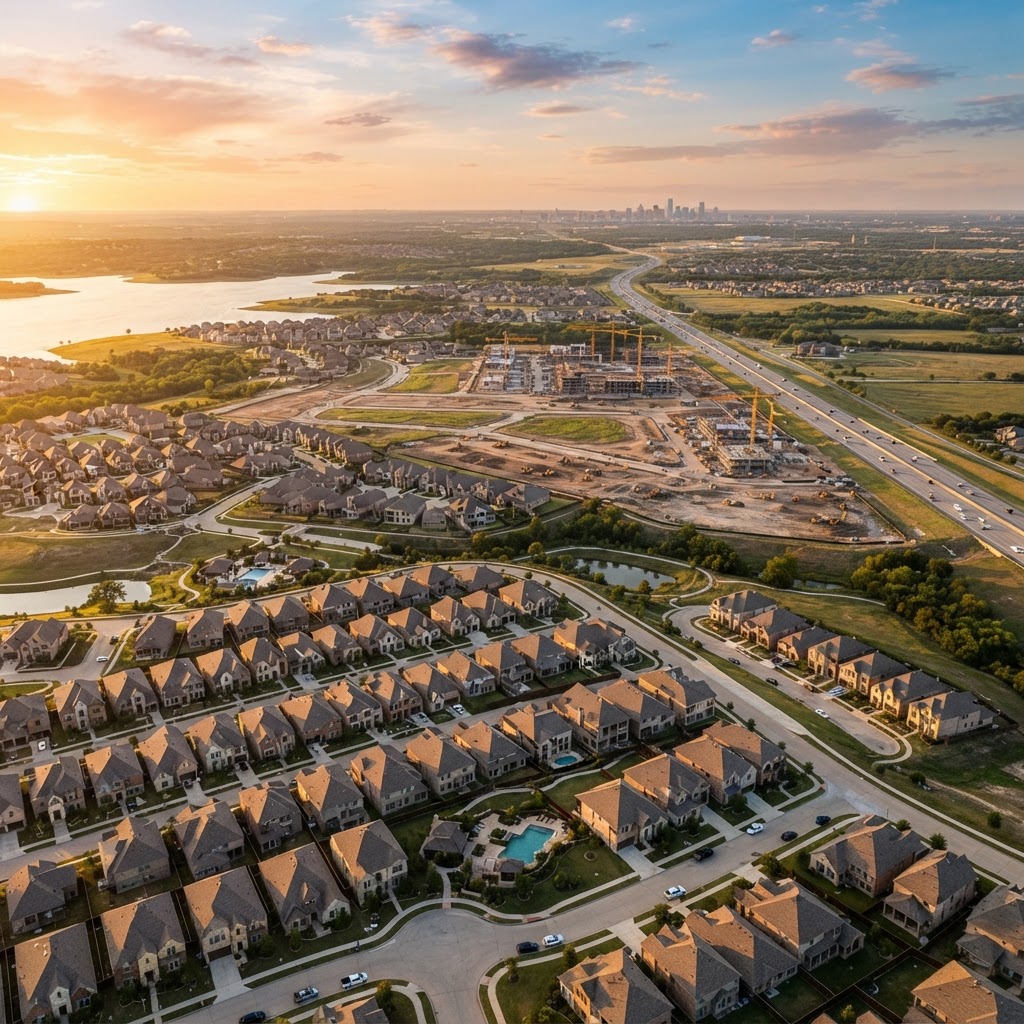
No metro in America has grown faster this decade than Dallas-Fort Worth. The region has added more than 150,000 residents per year — more than any other U.S. metro — driven by domestic migration from high-cost coastal states, one of the country's strongest job markets, and a business climate that keeps attracting corporate headquarters.
For real estate, this isn't a speculative bubble — it's a structural, multi-year demand wave. And the cities positioned to capture the strongest appreciation are the ones still early in their growth cycle, where infrastructure and rooftops are racing to keep up with people.
Why Everyone Is Moving to North Texas
Five structural forces are driving North Texas's growth, and none of them are likely to reverse soon:
- No state income tax — Texas is one of seven states with no personal income tax, which redirects 0–13% of income back to residents versus California, New York, and Illinois.
- Corporate relocations — DFW has landed 50+ major corporate headquarters in the last five years, including relocations from California (Tesla, Charles Schwab), Illinois ( Caterpillar), and beyond.
- Lower cost of living — even with rising DFW home prices, a $650K Frisco home replaces a $1.8M Bay Area home, freeing equity and reducing monthly costs.
- Job market depth — DFW consistently ranks among the top U.S. metros for job growth across tech, finance, healthcare, and logistics.
- New construction supply — unlike constrained coastal markets, North Texas has land and is building, which absorbs demand and keeps appreciation healthier than supply-starved markets.
The Fastest-Growing Cities (and Where the Upside Is)
Within North Texas, growth is concentrated along the northern expansion corridors in Collin and Denton counties. Here's how the fastest-growing cities stack up — and where the strongest appreciation potential sits:
| City | Pop. Growth (2020–26) | Median Home | Stage |
|---|---|---|---|
| Celina | +60% | $520K | Mid-growth |
| Princeton | +62% | $299K | Early-growth |
| Anna | +42% | $410K | Early-growth |
| Prosper | +38% | $720K | Mid-growth |
| Frisco | +28% | $650K | Mature |
| McKinney | +24% | $540K | Mature |
| Denton | +22% | $430K | Mid-growth |
The pattern is clear: the cities still in their early-growth stage — Princeton, Anna, and to a lesser degree Celina — combine the highest population growth with the lowest entry prices. That's the classic profile of strong appreciation ahead.
Infrastructure Investment Fueling the Next Wave
Three major infrastructure projects are about to be priced into North Texas real estate:
Dallas North Tollway Extension to Celina
The DNT is pushing north toward Celina — and tollway extensions have historically been the single most reliable catalyst for rapid property appreciation in North Texas.
McKinney National Airport Commercial Terminal
A $79M commercial terminal opening in late 2026 will bring scheduled passenger flights to Collin County, removing the last major objection for executive buyers.
US-380 Corridor Development
Retail, dining, and commercial development filling in along US-380 between McKinney and Princeton is rapidly reducing the 'middle of nowhere' concern that's kept prices low.
What This Means for Buyers and Investors in 2026
For buyers, the lesson is simple: the window to buy into North Texas's growth story at affordable entry prices is still open, but it's narrowing. The cities that have already matured (Frisco, Plano) offer stability and lifestyle but limited upside. The cities still early in growth (Princeton, Anna, Celina) offer the strongest appreciation potential — with the trade-off of longer commutes and less-developed amenities today.
For investors, the playbook is to identify the cities where population growth is outrunning new construction, where infrastructure is about to land, and where prices per square foot are still below the regional average. In 2026, that points clearly to the US-380 corridor (Princeton) and the US-75 north corridor (Anna, Melissa).
"North Texas's growth isn't slowing — it's spreading north. The buyers who understand the pattern and get positioned in the next-wave cities now will be the ones telling the appreciation story five years from now."
— MONTINA CLARK, REALTOR® | DALTON WADE REAL ESTATE GROUP
Frequently Asked Questions About North Texas Growth
WANT TO INVEST IN NORTH TEXAS GROWTH?
Montina Helps You Position for the Upside
From growth-cycle analysis to identifying the right neighborhood in the right city, Montina helps buyers and investors capture North Texas's growth story before it's fully priced in.